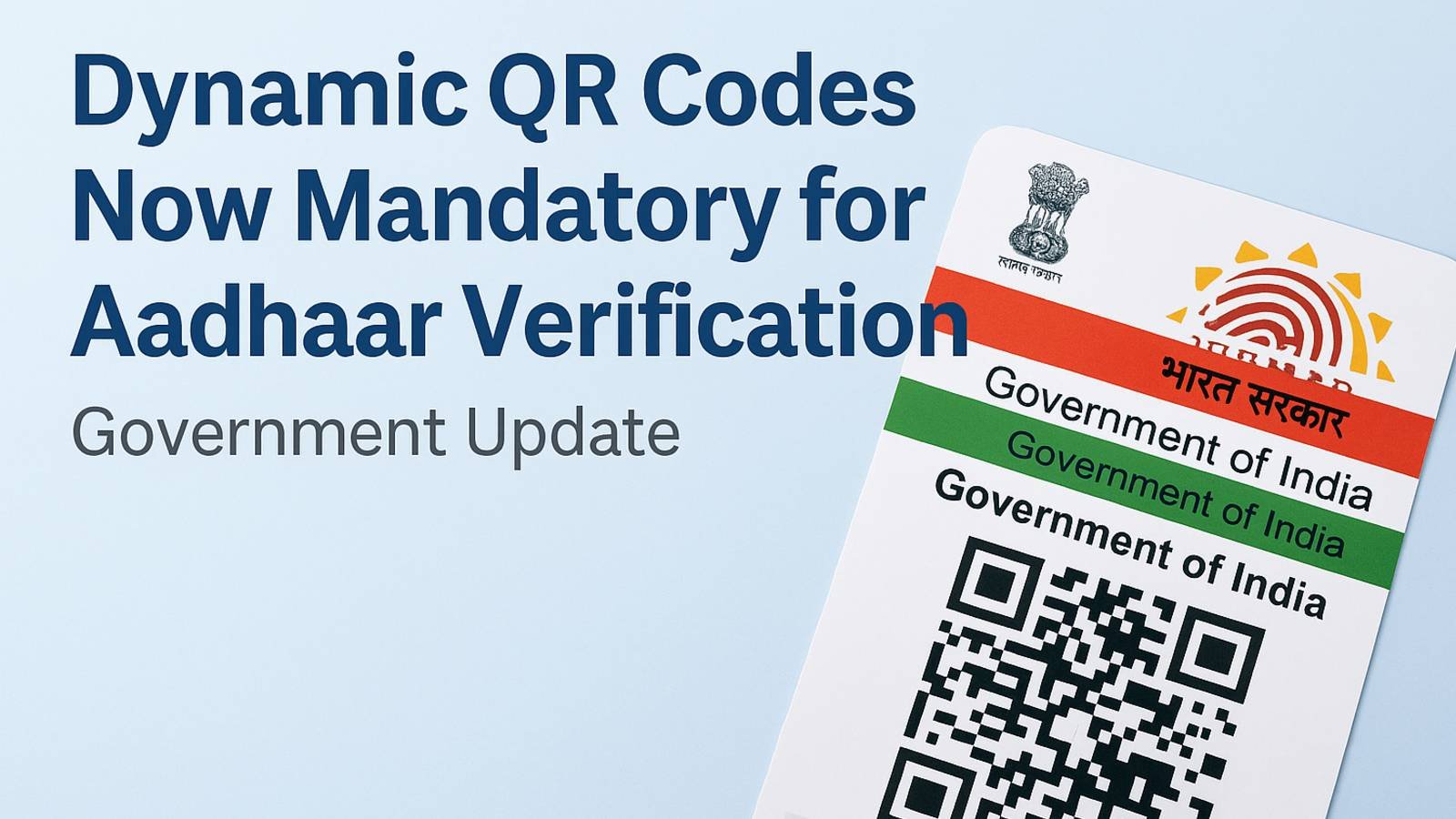
Dynamic QR Codes Now Mandatory for Aadhaar Verification – Government Update 2025

Table of Contents
The Government of India, along with UIDAI (Unique Identification Authority of India), has officially announced that Dynamic QR Codes will now be mandatory for Aadhaar verification across major sectors. This move aims to enhance the safety, authenticity, and accuracy of Aadhaar-based identity verification, reducing the risk of fraud and misuse.
The update comes as part of the government’s broader push toward secure digital identity frameworks and improved KYC (Know Your Customer) processes, especially in banking, telecom, travel, digital payments, and public welfare services.
What Are Dynamic QR Codes for Aadhaar?
Dynamic QR Codes are real-time generated QR codes that change every time a user initiates an Aadhaar verification request. Unlike static QR codes printed on Aadhaar cards, dynamic QR codes:
- Expire after a short period
- Cannot be reused
- Cannot be copied or forged
- Offer high-level encryption
- Are validated instantly through UIDAI’s server
This makes them far more secure than static Aadhaar QR codes, which have been vulnerable to screenshots, misuse, and fraud attempts.
Why Has the Government Made Dynamic QR Codes Mandatory?
According to the UIDAI notification:
“Dynamic QR-based Aadhaar verification will significantly reduce identity fraud and ensure a more secure digital ecosystem for citizens.”
Here are the key reasons behind this mandate:
1. Elimination of Fake Aadhaar Usage
Static QR codes can be screenshot, edited, or reused. Dynamic QR codes completely prevent this risk.
2. Real-Time Verification
Every scan pulls live data from UIDAI’s secured servers, ensuring the identity is authentic.
3. Strong Fraud Protection in Banking & KYC
Banks, NBFCs, and digital loan platforms face a high number of fake KYC attempts. Dynamic QR solves this.
4. Faster Verification Process
Dynamic QR codes reduce manual checks and simplify onboarding for customers.
5. Secure Aadhaar-Based Payments
As UPI payments grow rapidly, secure QR-based KYC becomes essential for fraud prevention.
Where Will Dynamic QR Aadhaar Verification Be Mandatory?
The government has mandated the use of dynamic QR codes in sectors where identity verification is sensitive:
✔ Banks & Financial Institutions
– Opening bank accounts
– Applying for loans
– Credit card applications
– Insurance KYC
✔ SIM Card Issuance
– New mobile connections
– eSIM activation
– Telecom KYC
✔ Digital Wallets & Fintech Apps
– Paytm
– PhonePe
– Google Pay
– Razorpay onboarding
✔ Travel & Hospitality
– Hotels
– Airports
– Ticket bookings
✔ Government Schemes
– Subsidy verification
– DBT onboarding
– Public welfare programs
✔ Corporate & Workplace Verification
– Employee ID verification
– Visitor verification
Anywhere Aadhaar KYC is used, dynamic QR will now replace static Aadhaar photocopies.
How Will Dynamic Aadhaar QR Code Verification Work?
The new verification process is simple:
Step 1:
User initiates verification (bank, SIM, service provider).
Step 2:
UIDAI generates a unique dynamic QR code for that user session.
Step 3:
The official scans the QR via registered UIDAI scanner.
Step 4:
UIDAI validates the QR code in real-time and returns:
– Name
– Photo
– Last 4 digits
– DOB
– Verification status
Step 5:
Verification completed within seconds.
This new system is fast, secure, and eliminates human error.
Benefits of Dynamic QR Codes for Indian Citizens
1. No photocopy or Aadhaar print needed
Digital verification becomes instant.
2. No fear of Aadhaar misuse
QR code cannot be reused or copied.
3. Faster onboarding
Banking, SIM activation, and services become quicker.
4. More secure digital identity
UIDAI encryption reduces fraud to nearly zero.
When Will This Update Be Fully Implemented?
The government has directed all major sectors to adopt the system by:
Deadline: 1 July 2025
Some sectors have already started using dynamic Aadhaar QR verification.
The Government’s decision to make Dynamic QR Codes mandatory for Aadhaar verification is a major step toward building a safer and more efficient digital India. With real-time validation, enhanced security, and faster processing, this update will transform how Aadhaar is used for KYC and identity verification across the country.
This policy ensures citizens’ identity remains protected while giving industries a more reliable verification method.
For more information, you can visit the official UIDAI website: